
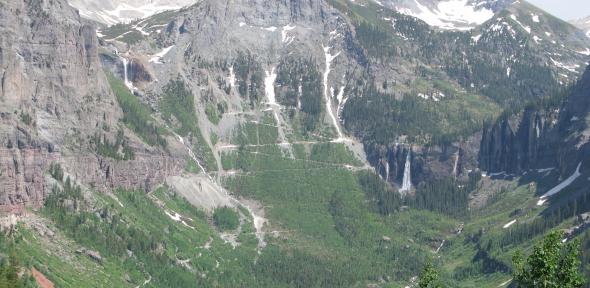
Telluride, Colorado: Tuesday July 7th to Saturday July 11th 2026
Organisers: Karl Heinz Hoffmann, Markus Pflaum, Christian Schön, David Wales
The workshop will start on Tuesday morning and run for five days, including Saturday.
Contributions are invited on all aspects of energy landscape research, covering exploration methodology from global optimisation, thermodynamic sampling, and rare events. One particular aim is to explore the connections between the topological and geometric properties of molecular landscapes, condensed matter, and the solution spaces for machine learning, self-consistent fields, and quantum computing.
Full details here https://meetings.telluridescience.org/meetings/workshop-details?wid=1289
Link to talk slides https://drive.google.com/drive/folders/1-_NEju9FBsS2Bg4ygJpEHSPkzYgvFPHq?usp=sharing
Schedule:
Workshop location: Telluride Science and Innovation Center: 300 S Townsend St, Telluride CO 81435
Breakfast will be available from 7:30am at the Telluride Science and Innovation Center every morning, and coffee, tea, other beverages, and snacks are available throughout the day.
Talks are all 30 minutes + 15 minutes discussion
Monday July 6th
5pm - 6:30pm Meet and Greet at the Telluride Science and Innovation Centre, 300 S Townsend St. Non- alcoholic drinks provided.
Tuesday July 7th
8.50 – 9.00 Welcome to Telluride Energy Landscapes 2026
presentation from the Pinhead Institute: Sarah
9.00 – 9.45 John Straub, "Probing the Energy Landscapes of Water in Amyloid Fibril Nanochannels"
9.45 – 10.30 Christian Schön, "Thoughts about optimising thermodynamic processes on complex energy landscapes"
10.30 - 11.00 coffee break
11.00 - 11:45 Michael K.-H Kiessling, "Mathematical results and conjectures about energy-minimising n-body clusters"
11.45 - 12:30 Patryk Wesołowski, "The AML-Associated A338V Mutation Rewires GPR183 Signaling Through C-Terminal Ensemble Redistribution"
Afternoon: suggested hike up Bear Creek
Wednesday July 8th
9.00 – 9.45 Tamiki Komatsuzaki, "Timescale Hierarchies in Large-Scale First-Order Kinetics: How to Coarse-Grain Complex Networks"
9.45 – 10.30 Diksha Dewan, "Sampling Energy Landscapes: From Biomolecules to Broken Ergodicity"
10.30-11.00 coffee break
11.00 - 11.45 Vladimir Mandelshtam, "Coarse- grained free energy surface with nearly exact thermodynamic consistency"
11.45 – 12.30 Sean Gasiorowski, "Goal-Aware Fine-Tuning of Foundation Models for Minimum Energy Pathway Discovery"
Afternoon: self-organisation. Bridal Veil hike suggested.
Evening: picnic from 5:30pm to 7:30pm tent behind the Intermediate School.
Thursday July 9th
Cleared for all day hiking.
Friday July 10th
9.00 - 9.45 Helmut Grubmueller, "Multi-timescale structural dynamics of the disordered N-terminal of p53, governed by a hierachical free energy landscape"
9.45 - 10.30 Agustin Lorusso Notaro Francesco, "Numerical Techniques for III-conditioned First Passage Time Calculations"
10.30 - 11.00 coffee break
11.00 - 11.45 Paula Teeuwen, "Exploring Energy Landscapes of Conformational Flexibility and Guest Dissociation in Metal-Organic Cages"
11.45 - 12.30 Gregory Berkolaiko, "Topology of the Ritz energy landscape"
Lunch break
14.30 - 15.15 Dave Leitner, "Vibrational energy landscapes and energy flow in proteins"
15.15 - 16.00 Jin Wang, "Landscape and flux as the driving forces for the nonequilibrium system dynamics"
16.00 - 16.45 Scott Woodley, TBA
There would be time for a short hike: Cornet Creek hike suggested.
Saturday July 11th
9.00 – 9.45 Erik Thiede, "Recovering Landscapes and Motion by Integrating Electron Microscopy and Molecular Modeling"
9.45 – 10.30 Choy Boy, "Exploring energy landscapes in quantum computing"
10.30 - 11.00 coffee break
11.00 - 11.45 Markus Pflaum, "Topological invariants of energy landscapes"
11.45 - 12.30 Karl Heinz Hoffmann, TBA
Participants:
Bjarne Andresen, University of Copenhagen
Gregory Berkolaiko, Texas A&M University "Topology of the Ritz energy landscape"
Choy Boy, University of Cambridge "Exploring energy landscapes in quantum computing"
Diksha Dewan, University of Cambridge "Sampling Energy Landscapes: From Biomolecules to Broken Ergodicity"
Sean Gasiorowski, Stanford University "Goal-Aware Fine-Tuning of Foundation Models for Minimum Energy Pathway Discovery"
Helmut Grubmueller, Max Planck Institute for Multidisciplinary Sciences, Goettingen "Multi-timescale structural dynamics of the disordered N-terminal of p53, governed by a hierarchical free energy landscape"
Karl Heinz Hoffmann, Technical University Chemnitz
Michael K.-H Kiessling, Rutgers, The State University of New Jersey "Mathematical results and conjectures about energy-minimising n-body clusters"
Tamiki Komatsuzaki, Hokkaido University "Timescale Hierarchies in Large-Scale First-Order Kinetics: How to Coarse-Grain Complex Networks"
Konstantin Kostov, Clairvoyance Capital
Dave Leitner, University of Nevada "Vibrational energy landscapes and energy flow in proteins"
Agustin Lorusso Notaro Francesco, University of Cambridge "Numerical Techniques for Ill-conditioned First Passage Time Calculations"
Vladimir Mandelshtam, University of California, Irvine "Coarse- grained free energy surface with nearly exact thermodynamic consistency"
Soonwoo Park, University of Cambridge "Predicting and Understanding Observable Properties of Molecules, Surfaces, and Solids from the Energy Landscape"
Markus Pflaum, University of Colorado, Boulder "Topological invariants of energy landscapes"
Christian Schön, Max Planck Institute for Solid State Research, Stuttgart "Thoughts about optimising thermodynamic processes on complex energy landscapes"
John Straub, Boston University "Probing the Energy Landscapes of Water in Amyloid Fibril Nanochannels"
Paula Teeuwen, University of Cambridge "Exploring Energy Landscapes of Conformational Flexibility and Guest Dissociation in Metal-Organic Cages"
Erik Thiede, Cornell University "Recovering Landscapes and Motion by Integrating Electron Microscopy and Molecular Modeling"
David J. Wales, University of Cambridge
Jin Wang, Stony Brook University "Landscape and flux as the driving forces for the nonequilibrium system dynamics"
Patryk Wesołowski, University of Cambridge "The AML-Associated A338V Mutation Rewires GPR183 Signaling Through C-Terminal Ensemble Redistribution"
Scott Woodley, University College London