
Professor of Chemical Physics

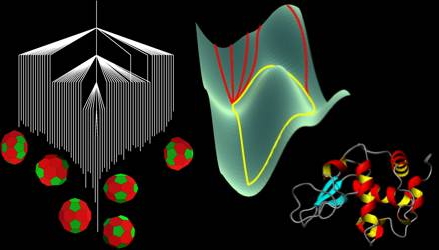
The self-assembly of complex mesoscopic structures, the folding of proteins, and the complicated phenomenology of glasses are all manifestations of the underlying potential energy surface (PES). In each of these fields related ideas have emerged to explain and predict chemical and physical properties in terms of the PES. In studies of clusters and glasses the PES itself is often investigated directly, whereas for proteins and other biomolecules it is also common to define free energy surfaces, as the figure below illustrates for lysozyme.

Applications of energy landscape theory in my group range from studies of tunnelling splitting patterns in small molecules to computer simulation of protein folding and misfolding, including aggregation of misfolded proteins. Other active research topics include global optimisation and investigation of how the thermodynamic and dynamic properties of glasses are related to the underlying PES.

Two recent advances are now providing new insight into larger systems. Discrete path sampling enables dynamical properties to be obtained efficiently, and is being used to calculate folding rates for proteins. Unexpected connections between dynamics and thermodynamics have also been revealed by the application of catastrophe theory to energy landscapes, and new results are now being obtained to characterize phase transitions.

Publications

GPU-Accelerated Exploration of Biomolecular Energy Landscapes
RG Mantell, CE Pitt, DJ Wales
Journal of Chemical Theory and Computation
(2016)
12
Structure, Thermodynamics, and Folding Pathways for a Tryptophan Zipper as a Function of Local Rigidification
JA Joseph, CS Whittleston, DJ Wales
Journal of Chemical Theory and Computation
(2016)
12
Coarse-Grained Simulations Complemented by Atomistic Molecular Dynamics Provide New Insights into Folding and Unfolding of Human Telomeric G-Quadruplexes
P Stadlbauer, L Mazzanti, T Cragnolini, DJ Wales, P Derreumaux, S Pasquali, J Šponer
Journal of Chemical Theory and Computation
(2016)
12
Probing helical transitions in a DNA duplex†
DJ Wales, D Chakraborty
Physical Chemistry Chemical Physics
(2016)
Impurity effects on solid–solid transitions in atomic clusters
BE Husic, D Schebarchov, DJ Wales
Nanoscale
(2016)
8
Potential energy landscapes of tetragonal pyramid molecules
Y Yoshida, H Sato, JWR Morgan, DJ Wales
Chemical Physics Letters
(2016)
664
Prediction of Sepsis in the Intensive Care Unit With Minimal Electronic Health Record Data: A Machine Learning Approach
T Desautels, J Calvert, J Hoffman, M Jay, Y Kerem, L Shieh, D Shimabukuro, U Chettipally, MD Feldman, C Barton, DJ Wales, R Das
Jmir Medical Informatics
(2016)
4
Preventing Structural Rearrangements on Battery Cycling: A First-Principles Investigation of the Effect of Dopants on the Migration Barriers in Layered Li0.5MnO2
ID Seymour, DJ Wales, CP Grey
The Journal of Physical Chemistry C
(2016)
120
Structural analysis of high-dimensional basins of attraction.
S Martiniani, KJ Schrenk, JD Stevenson, DJ Wales, D Frenkel
Physical review. E
(2016)
94
Trapping of hydrogen atoms inside small beryllium clusters and their ions
FY Naumkin, DJ Wales
Chemical Physics Letters
(2016)
659

Head of group

Research Interest Groups

Telephone number

01223 336354

Email address

Upcoming Events

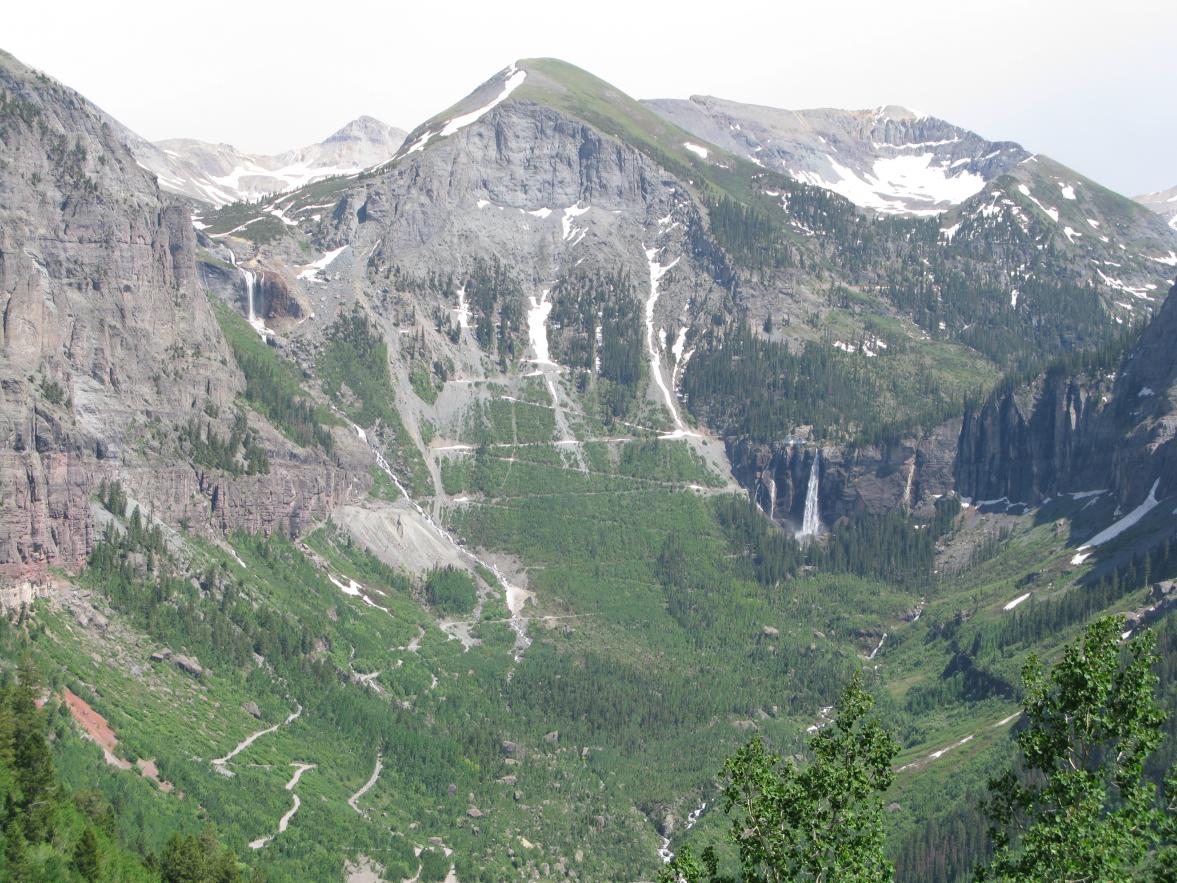
Energy Landscapes 2026 Telluride

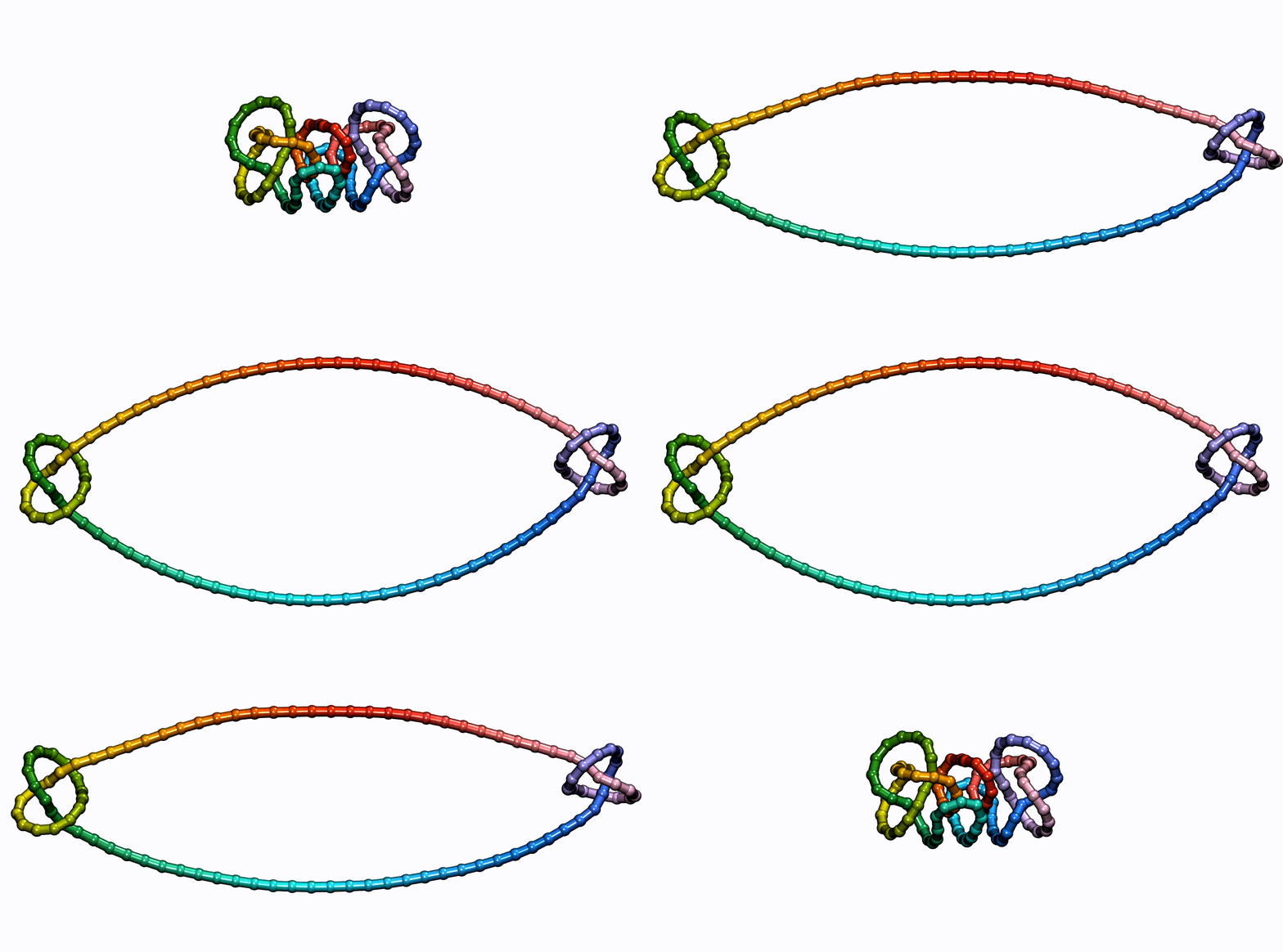
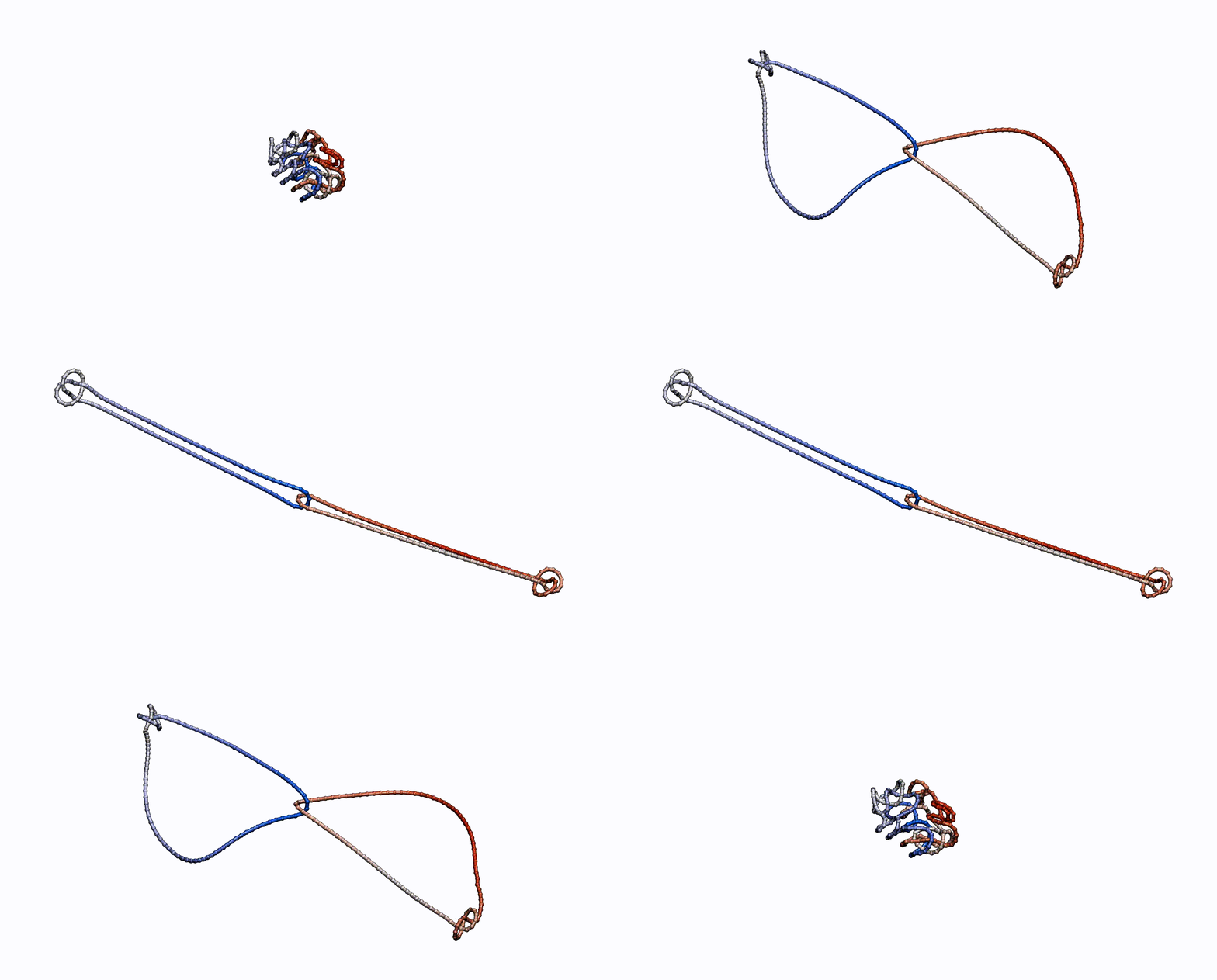
Click on an image to view animations from Energy Landscapes of Model Knotted Polymers, Journal of Chemical Theory and Computation, Tongfan Hao, Yinghao Ge, Mark A. Miller, Agustin L. N. Francesco, David J. Wales, DOI 10.1021/acs.jctc.5c01005

composite knot

link knot